

Dr. Sanjay Gupta
Consultant Orthopaedic & Joint Replacement Surgeon
Hip Replacement Recovery: 7 Key Stages of the Timeline
Hip replacement recovery is a gradual process that usually improves week by week as pain decreases, mobility improves and the hip becomes stronger. While many patients become more independent within the first few weeks, complete recovery can take several months and varies from person to person.
Understanding the hip replacement recovery timeline can help you know what to expect after surgery, including walking, exercises, daily activities and common recovery milestones.
Quick Answer
Most patients begin walking soon after hip replacement surgery, usually with support initially. During the first few weeks, the focus is on controlling pain and swelling, walking safely and performing prescribed exercises. Mobility generally continues to improve over the following weeks, while strength and confidence may continue developing for several months.

What Is the Typical Hip Replacement Recovery Timeline?
The recovery period after hip replacement is not identical for every patient. Age, general health, muscle strength, the type of surgery, activity level and adherence to rehabilitation can all influence recovery.
In general, recovery can be understood in several stages. Early recovery focuses on safe movement and basic independence, while later stages focus on rebuilding strength, returning to normal activities and gradually increasing activity levels.
First 24 Hours
Initial movement, pain control and assisted walking may begin.
Week 1
Walking and prescribed exercises gradually become part of the daily routine.
Week 2
Mobility and confidence may begin improving as activity increases gradually.
Weeks 3–6
Strength, walking ability and independence generally continue improving.
Weeks 6–12
Many patients gradually return to more routine daily activities.
Months 3–6
Strength and function can continue improving with regular activity.
Beyond 6 Months
Further improvements in strength, comfort and confidence may continue.
1. First 24 Hours After Hip Replacement
Early movement is an important part of recovery after hip replacement surgery. Depending on your medical condition and your surgeon’s rehabilitation plan, you may be helped to stand and walk with an appropriate walking aid.
During this stage, the focus is usually on pain management, safe movement, basic exercises and preventing complications associated with prolonged inactivity.
- Assisted standing and walking may begin.
- A walker or other walking aid may be used.
- Simple exercises may be introduced.
- Pain and swelling are monitored.
- Instructions for movement and wound care are provided.
2. Hip Replacement Recovery During Week 1
The first week at home is generally focused on becoming more independent while protecting the healing hip. Walking should usually be increased gradually rather than suddenly.
Your physiotherapy or exercise programme may include movements designed to improve circulation, maintain muscle activity and gradually restore mobility.
- Continue prescribed exercises regularly.
- Walk short distances as advised.
- Use walking support when required.
- Follow wound-care instructions.
- Allow adequate rest between activities.
3. Hip Replacement Recovery in Week 2
By the second week, some patients begin noticing improvements in walking and everyday movement. However, recovery speed varies considerably, so progress should be based on your own symptoms and your surgeon’s advice.
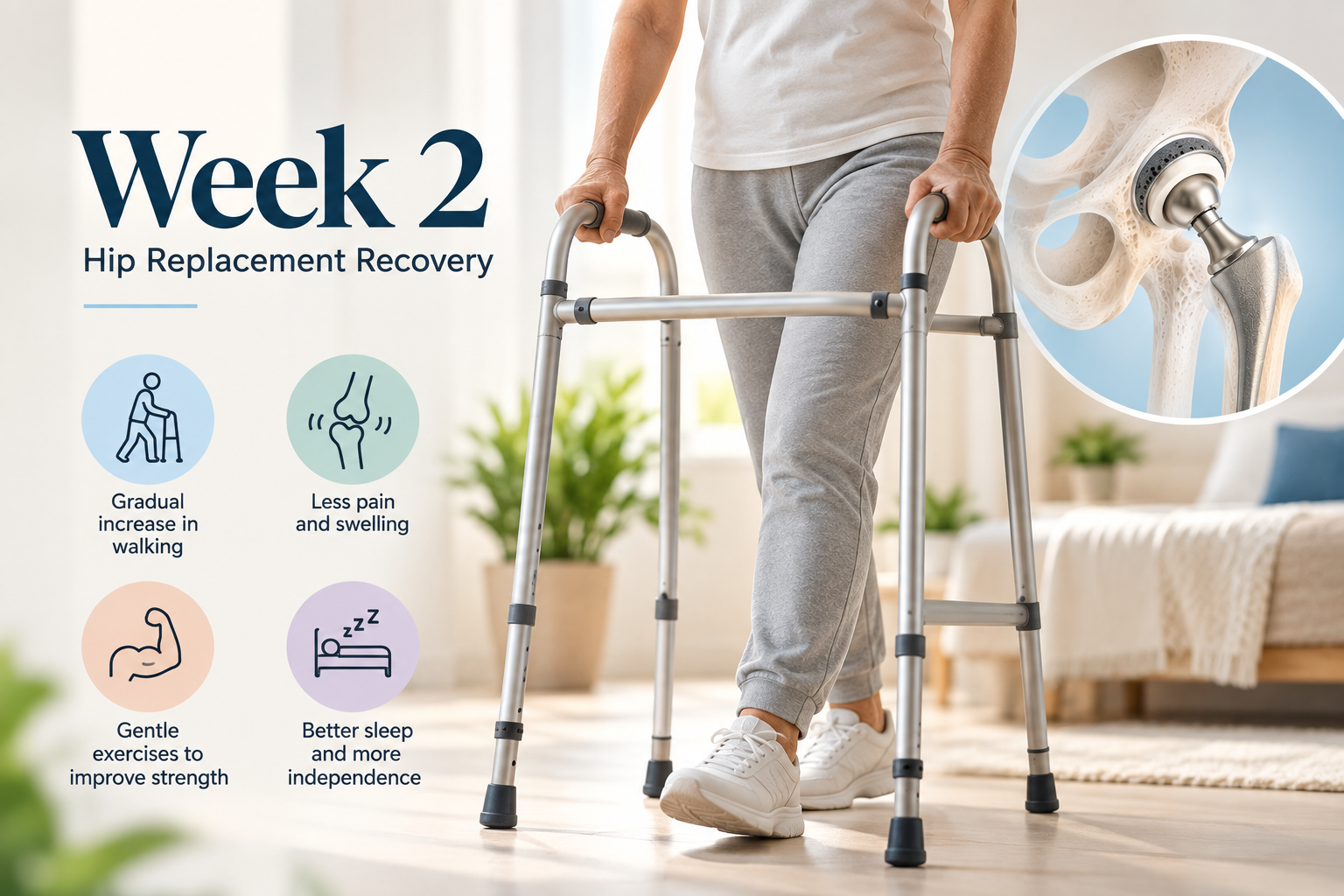
Continue increasing walking and exercises gradually. You may still experience some discomfort, stiffness or swelling, particularly after increased activity.
4. Weeks 3–6: Building Strength and Independence
During weeks three to six, many patients gradually become more comfortable with routine activities. Walking distance may increase and dependence on walking aids may decrease when strength and balance improve.
Your rehabilitation programme may become progressively more challenging as your hip and surrounding muscles become stronger.
- Gradually increase walking distance.
- Continue prescribed strengthening exercises.
- Work towards safer and more independent daily movement.
- Follow restrictions provided by your surgical team.
- Avoid suddenly increasing activity levels.
5. Weeks 6–12: Returning to Routine Activities
Around six to twelve weeks, many patients are able to resume a greater range of everyday activities, depending on their recovery and the advice of their healthcare team.
Some patients may be able to return to driving or work around this period, but there is no universal date. Your ability to control the vehicle, react safely and perform your job should be considered before returning.
Continue strengthening and gradually increasing activity rather than assuming that the hip is completely healed simply because daily activities feel easier.
6. Months 3–6: Continued Improvement
Hip replacement recovery can continue well beyond the first few weeks. Between approximately three and six months, strength, mobility and confidence may continue to improve as the muscles around the hip become stronger.
Regular low-impact physical activity can be an important part of maintaining strength and mobility, provided it is appropriate for your individual recovery.
7. Beyond 6 Months: Long-Term Recovery
Some patients continue experiencing improvements in comfort and function beyond six months. Recovery is not necessarily complete at a specific date, and individual results can vary.
Your long-term activity programme should take into account your overall health, strength, surgical outcome and recommendations from your orthopaedic surgeon.
Hip Replacement Recovery Timeline at a Glance
| Recovery Stage | Typical Focus | What May Improve |
|---|---|---|
| First 24 hours | Early movement and pain control | Basic mobility |
| Week 1 | Walking and prescribed exercises | Basic independence |
| Week 2 | Gradual increase in activity | Walking confidence |
| Weeks 3–6 | Strength and mobility | Daily activities |
| Weeks 6–12 | Increasing routine activities | Function and independence |
| Months 3–6 | Strength and conditioning | Comfort and endurance |
| Beyond 6 months | Long-term activity | Further functional improvement |
How Long Does Pain Last After Hip Replacement?
Pain and discomfort are common during the early stages of hip replacement recovery. Pain generally becomes more manageable as healing progresses, but the exact duration varies between patients.
Swelling can also persist for some time, particularly after increased activity. Following your prescribed medication, activity and rehabilitation instructions can help support recovery.
When Can You Walk Normally After Hip Replacement?
Walking usually begins soon after surgery with assistance. Many patients gradually move from a walker or other support to more independent walking as strength and balance improve.
The timing of walking without assistance varies. Your surgeon or physiotherapist can determine when it is safe to reduce or stop using a walking aid.
Exercises During Hip Replacement Recovery
Exercises prescribed after surgery are intended to support mobility, circulation and muscle strength. Your rehabilitation programme should be followed according to the instructions provided by your orthopaedic team.
Avoid adding strenuous exercises or suddenly increasing activity without discussing them with your healthcare professional.
Returning to Daily Activities After Hip Replacement
Everyday activities are generally resumed gradually. Tasks such as bathing, dressing, climbing stairs and getting in and out of a chair may initially require additional care or assistance.
As mobility improves, many patients gradually return to their usual routines. However, specific movement precautions may apply depending on the surgical approach and individual circumstances.
When Can You Drive After Hip Replacement?
The time needed before driving varies between patients. You should be able to control the vehicle safely, perform an emergency stop and no longer be significantly affected by medication that could impair driving.
Always follow your surgeon’s advice and check applicable driving requirements before returning to the road.
When Can You Return to Work?
Returning to work depends on the type of job and the individual’s recovery. People with desk-based work may return earlier than those whose jobs involve prolonged standing, heavy lifting or physically demanding activity.
Your surgeon can advise when you are ready to return based on your progress and job requirements.
What Factors Can Affect Hip Replacement Recovery Time?
Several factors can influence hip replacement recovery time, including:
- Age and general health
- Muscle strength before surgery
- Level of physical activity
- Type of hip replacement procedure
- Consistency with prescribed rehabilitation
- Other medical conditions
- Individual healing response
Because these factors differ between patients, a personalised recovery plan is more useful than comparing your recovery directly with someone else’s.
Learn More About Hip Replacement Surgery
If you are considering surgery or want to understand the procedure in more detail, read our detailed guide to
hip replacement surgery
.
Trusted Resources for Hip Replacement Recovery
For additional patient information about recovery after hip replacement surgery, you can also refer to these trusted medical resources:
These resources provide general patient information. Your orthopaedic surgeon and physiotherapist’s instructions should take priority for your individual recovery.
When Should You Contact Your Doctor?
Contact your surgical team promptly if you experience symptoms that concern you or appear to be getting worse rather than improving.
Seek medical advice if you notice:
- Increasing or severe pain
- Significant or worsening swelling
- Fever or chills
- Redness or drainage around the wound
- Sudden difficulty walking
- New or unusual symptoms after surgery
If you experience severe or potentially life-threatening symptoms, seek urgent medical attention.
Looking for a Hip Replacement Surgeon in Noida?
If you are considering hip replacement and looking for an experienced orthopaedic specialist, you can learn more about
Dr. Sanjay Gupta’s orthopaedic and joint replacement services
.
Patients can also explore related information about
knee replacement surgery
and
total knee replacement in Noida, Vaishali and Ghaziabad
.
Frequently Asked Questions About Hip Replacement Recovery
How long does hip replacement recovery take?
Hip replacement recovery varies between patients. Many people become progressively more independent during the first several weeks, while strength and function can continue improving for several months.
How long does it take to walk normally after hip replacement?
Walking begins early in many recovery programmes, usually with support. The time needed to walk comfortably without an aid depends on strength, balance, healing and individual recovery.
Can I climb stairs after hip replacement?
Many patients can use stairs with appropriate instruction during early recovery. Your physiotherapist or surgical team can show you the safest technique for your individual situation.
When can I return to work after hip replacement?
Return-to-work timing depends on the type of work and recovery progress. Desk-based work may be possible earlier than physically demanding jobs.
When can I drive after hip replacement?
Driving should only resume when you can safely control the vehicle and perform an emergency stop, and when your surgeon considers it appropriate.
Does hip replacement recovery continue after three months?
Yes. Improvements in strength, mobility and comfort can continue for several months after surgery, depending on the individual patient.
Discuss Your Hip Replacement Recovery With Dr. Sanjay Gupta
Every patient’s recovery is different. If you have questions about hip replacement surgery, recovery time, mobility or rehabilitation, a personalised assessment can help you understand what to expect.
📍 3D-5L, Wave City Centre, Sector 32, Noida, Uttar Pradesh
📞 +91 8826318986 | +91 7303804513
📧 sanjaigupta06@gmail.com
Conclusion
Hip replacement recovery is a gradual process rather than a fixed schedule. Early recovery focuses on safe movement, pain management and rehabilitation, while the following weeks and months focus on improving strength, mobility and independence.
Understanding the hip replacement recovery timeline can help patients prepare for each stage, but your own recovery should always be guided by your orthopaedic surgeon and rehabilitation team.

