

Dr Sanjay Gupta Robotic Knee Replacement: 7 Key Benefits & Facts
Understand the difference between robotic and traditional knee replacement, the potential benefits of robotic assistance, who may benefit from it, and how Dr Sanjay Gupta evaluates the right treatment approach for each patient.

Medically Reviewed / Attributed To
Dr Sanjay Gupta
Orthopaedic & Joint Replacement Surgeon
Robotic vs Traditional Knee Replacement: What Is the Difference?
Knee replacement surgery is an established treatment for people with advanced knee arthritis, severe cartilage damage, persistent knee pain and difficulty performing everyday activities. Today, patients may undergo either conventional knee replacement or robotic-assisted knee replacement depending on their condition and surgical requirements.
Dr Sanjay Gupta robotic knee replacement is based on the principle that robotic technology should support surgical planning and precision while the surgeon remains responsible for clinical decisions and the procedure itself. Robotic assistance is therefore a surgical tool, not a replacement for the experience and judgement of an orthopaedic surgeon.
For someone looking for a Dr Sanjay Gupta knee replacement surgeon, understanding this difference is important. The decision between robotic and traditional surgery should be made after reviewing symptoms, physical examination findings, X-rays, knee alignment, joint damage, overall health and individual treatment goals.
Quick Answer
Both robotic-assisted and traditional knee replacement can be appropriate treatments. Robotic assistance may provide additional support for surgical planning and implant positioning, while traditional knee replacement remains an established option for many patients. The right approach depends on the patient’s anatomy, knee condition and the surgeon’s treatment plan.
What Is Traditional Knee Replacement?

Traditional knee replacement uses established surgical techniques and standard instruments to position the artificial knee joint.
Traditional knee replacement, also called conventional knee replacement, uses standard surgical instruments and established surgical techniques. The surgeon assesses the patient’s anatomy, removes the damaged portions of the knee and positions the artificial components according to the planned surgical technique.
Traditional total knee replacement has been used successfully for many years and remains an important option for patients with advanced osteoarthritis and other conditions that have significantly damaged the knee joint.
The success of traditional knee replacement depends on several factors, including appropriate patient selection, implant choice, accurate surgical technique, postoperative care and rehabilitation.
What Is Robotic Knee Replacement?
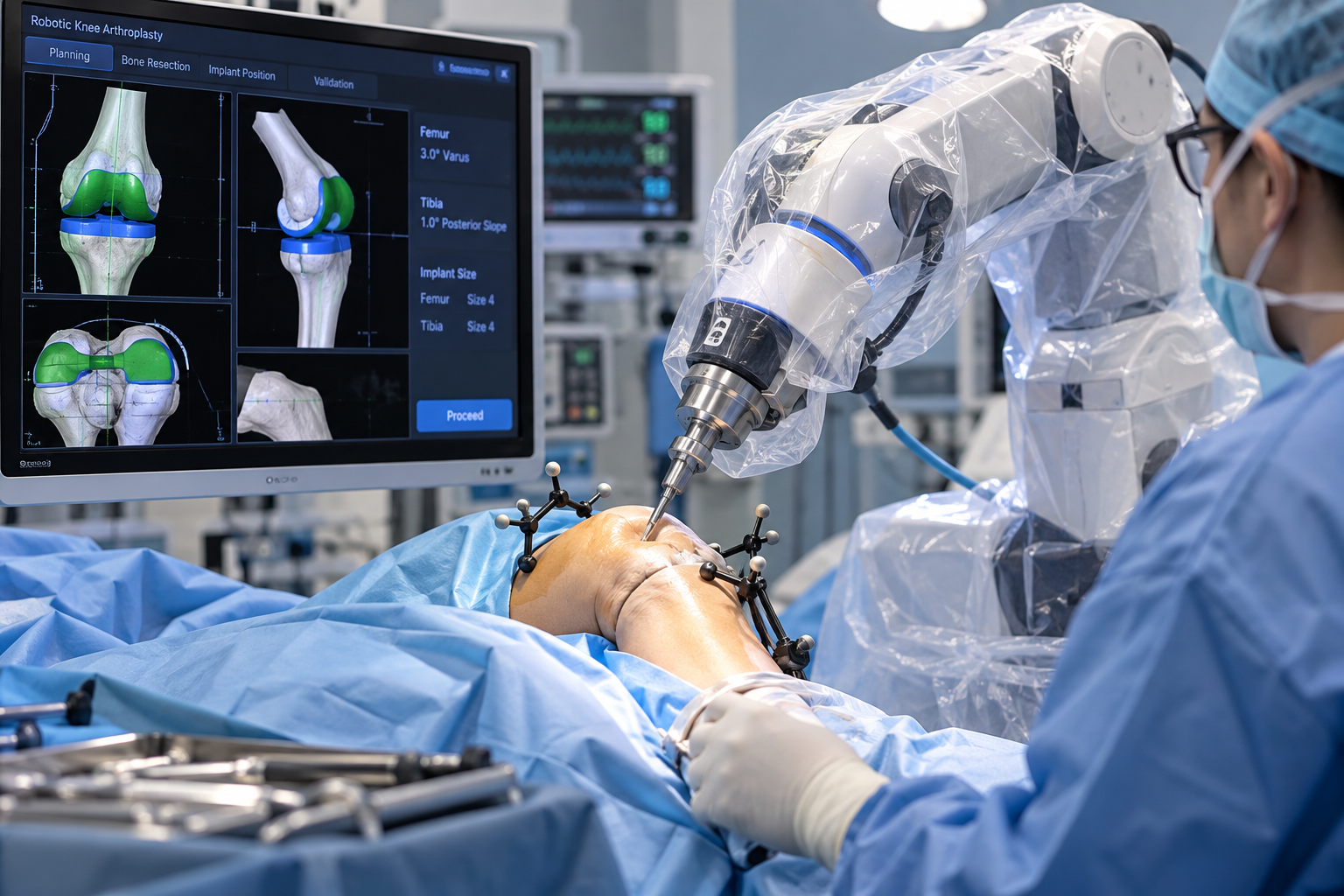
Robotic-assisted knee replacement can support surgical planning and implant positioning.
Robotic knee replacement combines conventional surgical principles with computer-assisted planning and robotic technology. Depending on the robotic system being used, information about the patient’s knee anatomy can assist the surgeon in planning bone preparation, alignment and implant positioning.
Importantly, robotic technology does not independently perform the entire knee replacement. The surgeon continues to make the important clinical decisions and controls the surgical process. The robotic system functions as an additional tool that can assist with specific parts of the operation.
For patients considering Dr Sanjay Gupta robotic knee replacement, the key question is whether robotic assistance offers a useful advantage for their individual anatomy and surgical requirements.
Robotic vs Traditional Knee Replacement: Key Differences
| Factor | Traditional Knee Replacement | Robotic Knee Replacement |
|---|---|---|
| Planning | Uses established surgical planning and standard instruments. | Uses computer-assisted planning and robotic technology. |
| Technology | Conventional surgical instruments. | Computer-assisted and robotic technology. |
| Alignment | Based on established surgical techniques and anatomical landmarks. | Technology can assist the surgeon with planned alignment and implant positioning. |
| Surgeon’s Role | The surgeon plans and performs the procedure. | The surgeon remains responsible for planning, decisions and execution. |
| Suitability | Appropriate for many patients requiring knee replacement. | May be considered when robotic assistance is clinically appropriate. |
Who May Need Robotic Knee Replacement?
There is no single type of patient who automatically needs robotic knee replacement. Robotic assistance may be considered for patients who require knee replacement and may benefit from computer-assisted planning or robotic guidance.
A Dr Sanjay Gupta knee replacement surgeon may consider factors such as knee deformity, bone anatomy, ligament condition, previous surgery, severity of arthritis and the complexity of the planned procedure when discussing whether robotic assistance is appropriate.
- Patients with advanced knee arthritis requiring knee replacement.
- Patients where detailed anatomical planning may be useful.
- Patients with complex knee anatomy or previous surgical changes.
- Patients who are otherwise suitable candidates for knee replacement surgery.
Who May Be Suitable for Traditional Knee Replacement?
Traditional knee replacement remains an established treatment option for many patients with advanced arthritis. If conventional instrumentation can achieve the required surgical plan effectively, robotic assistance may not be necessary for that individual.
A patient should not choose a surgical technique solely because it uses newer technology. The appropriate procedure depends on the individual’s symptoms, imaging, anatomy, medical history and surgical requirements.
Robotic Knee Replacement in Noida
Patients looking for robotic knee replacement in Noida should discuss both robotic-assisted and conventional options with an experienced orthopaedic surgeon. The consultation should include an assessment of the knee, relevant imaging and a discussion of the expected benefits, limitations and recovery process.
You can learn more about the overall procedure on the Knee Replacement Surgery page and explore the dedicated Total Knee Replacement in Noida treatment page.
What Does Current Evidence Say?
Current clinical guidance does not suggest that robotic-assisted knee replacement is automatically better for every patient. The American Academy of Orthopaedic Surgeons (AAOS) reports that evidence shows no significant short-term difference in function, outcomes or complications between robotic-assisted and conventional total knee arthroplasty, although robotic technology may improve aspects of surgical accuracy.
NICE guidance also describes robot-assisted surgery as a technology that supports the surgeon and notes that clinical judgement should be used when deciding whether robotic-assisted or conventional surgery is most appropriate for an individual patient.
For patients and families researching robotic knee replacement, reviewing reliable clinical guidance can help provide context alongside a personalised consultation.
Read the AAOS guidance on robotics in total knee arthroplasty
Read the NICE guidance on robot-assisted surgery for orthopaedic procedures
Is Robotic Knee Replacement Better Than Traditional Surgery?
Robotic-assisted surgery can provide additional technological support for planning and implant positioning. However, greater technical precision does not automatically mean that every patient will have better long-term results.
Current clinical guidance suggests that robotic assistance can improve aspects of surgical precision, while evidence regarding improved long-term patient outcomes remains less certain. Therefore, the technology should be considered as part of the overall surgical plan rather than as a guarantee of better results.
The experience of the surgeon, appropriate patient selection, implant choice, surgical technique and postoperative rehabilitation all remain important components of knee replacement care.
7 Key Benefits of Robotic-Assisted Knee Replacement
1. Detailed Planning
Computer-assisted planning can provide additional anatomical information before and during surgery.
2. Alignment Assistance
Robotic technology can assist the surgeon with planned bone preparation and implant positioning.
3. Patient-Specific Planning
The surgical plan can incorporate information about the patient’s individual knee anatomy.
4. Surgical Guidance
Robotic systems can provide additional guidance during selected stages of knee replacement surgery.
5. Anatomical Assessment
Technology can help the surgical team assess anatomical information relevant to the planned procedure.
6. Implant Positioning Support
Robotic assistance may support the surgeon in achieving the planned implant positioning.
7. Technology-Assisted Precision
Robotic systems can add technology-assisted precision to selected parts of the surgical process.
Does Robotic Knee Replacement Mean Faster Recovery?
Recovery after knee replacement varies between patients. Age, muscle strength, general health, severity of joint damage, surgical complexity and participation in rehabilitation can all influence recovery.
Robotic assistance should not be presented as a guarantee of faster recovery or less pain. Physiotherapy, appropriate postoperative care and gradual return to activity remain important regardless of whether the knee replacement is performed using robotic-assisted or traditional techniques.
Dr Sanjay Gupta and Knee Replacement Surgery
Dr Sanjay Gupta is an Orthopaedic and Joint Replacement Surgeon who provides evaluation and treatment for patients requiring knee replacement surgery. His approach involves assessing the patient’s symptoms, clinical findings and imaging before determining the most appropriate treatment strategy.
For patients specifically researching Dr Sanjay Gupta robotic knee replacement, the consultation can help determine whether robotic assistance is appropriate or whether a traditional knee replacement would adequately address the patient’s condition.
Patients searching for a knee replacement surgeon in Noida should consider factors such as relevant orthopaedic experience, joint replacement expertise, appropriate patient selection, implant knowledge, postoperative care and the surgeon’s ability to explain available treatment options clearly.
Questions to Ask Before Choosing Robotic or Traditional Knee Replacement
- Do I actually need knee replacement surgery?
- Would robotic assistance be useful for my specific knee condition?
- What type of knee replacement implant is being considered?
- What are the expected benefits and possible risks?
- How long may rehabilitation take?
- What activities can I expect to return to after surgery?
Frequently Asked Questions About Robotic Knee Replacement
What is robotic knee replacement?
Robotic knee replacement is a knee replacement procedure in which computer-assisted planning and robotic technology are used to support the surgeon during selected stages of the operation.
Is robotic knee replacement better than traditional knee replacement?
Robotic assistance may improve the precision of surgical planning and implant positioning, but it is not automatically better for every patient. The appropriate approach depends on the patient’s individual condition and surgical requirements.
Who can consider Dr Sanjay Gupta robotic knee replacement?
Patients who require knee replacement can discuss robotic-assisted surgery with Dr Sanjay Gupta to determine whether the technology is appropriate for their anatomy, condition and surgical plan.
How do I find a knee replacement surgeon in Noida?
When choosing a knee replacement surgeon in Noida, consider relevant orthopaedic and joint replacement experience, the surgeon’s approach to patient selection, available treatment options, postoperative rehabilitation and the ability to explain expected benefits and risks.
Where can I learn more about knee replacement surgery?
You can read the detailed knee replacement surgery guide or explore the page about total knee replacement in Noida.
Dr Sanjay Gupta – Location & Contact Details
If you are looking for a knee replacement surgeon in Noida or want to discuss robotic or traditional knee replacement, you can contact Dr Sanjay Gupta for a consultation.
📍 SG Clinic – Noida
3D-5L, Wave City Centre,
Sector 32, Noida – 201301
🌐 Official Website
Visit the official website to learn more about Dr Sanjay Gupta, available treatments and consultation options.
📞 Book a Consultation
Dr Sanjay Gupta Robotic Knee Replacement: Making an Informed Choice
Robotic and traditional knee replacement are both established surgical approaches. Robotic-assisted technology can provide additional support for planning and surgical precision, while conventional knee replacement remains an effective option for many patients.
The decision should not be based simply on whether a procedure is robotic or traditional. A detailed assessment of the knee, imaging, symptoms, anatomy and individual treatment goals is essential when selecting the appropriate surgical approach.
If you are considering Dr Sanjay Gupta robotic knee replacement, discuss your condition and available treatment options during a personalised consultation.
Discuss Your Knee Replacement Options
If you are considering robotic or traditional knee replacement, discuss your symptoms, imaging and treatment options with Dr Sanjay Gupta.
Medical Review / Attribution: This article is medically reviewed/attributed to Dr Sanjay Gupta, Orthopaedic & Joint Replacement Surgeon. The information is provided for general educational purposes and should not replace an individual medical consultation, examination or personalised treatment plan.

