

Indian Toilet and Floor Sitting After Knee Replacement: What Is Safe, What to Avoid and When
Indian toilet after knee replacement is one of the first worries patients raise, and it is rarely about the toilet alone. In most Indian homes, the floor is part of daily life. We eat on it, pray on it, sit with guests on it and use a squat toilet that is built into it. So when a patient is told they need surgery, the quieter question is often: will I still be able to live the way I always have?
This guide answers that honestly. It explains how to manage an Indian toilet after knee replacement, how much knee bend each activity needs, what floor sitting after knee replacement looks like at each stage, how to set up your bathroom before surgery, and how to take part in family and religious life without putting your new knee at risk. It reflects the practical approach followed by Dr. Sanjay Gupta, an orthopaedic surgeon in Noida with about 25 years of experience in joint replacement.
Quick Answer
Can I use an Indian toilet after knee replacement, or sit on the floor?
Not in the early months. For at least the first 6 to 12 weeks, a Western seat or a commode chair after knee replacement, placed over the Indian pan, is the safe choice. After that, using an Indian toilet after knee replacement, floor sitting and squatting depend on how far your knee bends, how strong your thighs are and what your surgeon advises. Some patients return to these positions, many do not, and most are still very happy with the result. Pain-free walking, stairs and sleep matter far more than squatting.
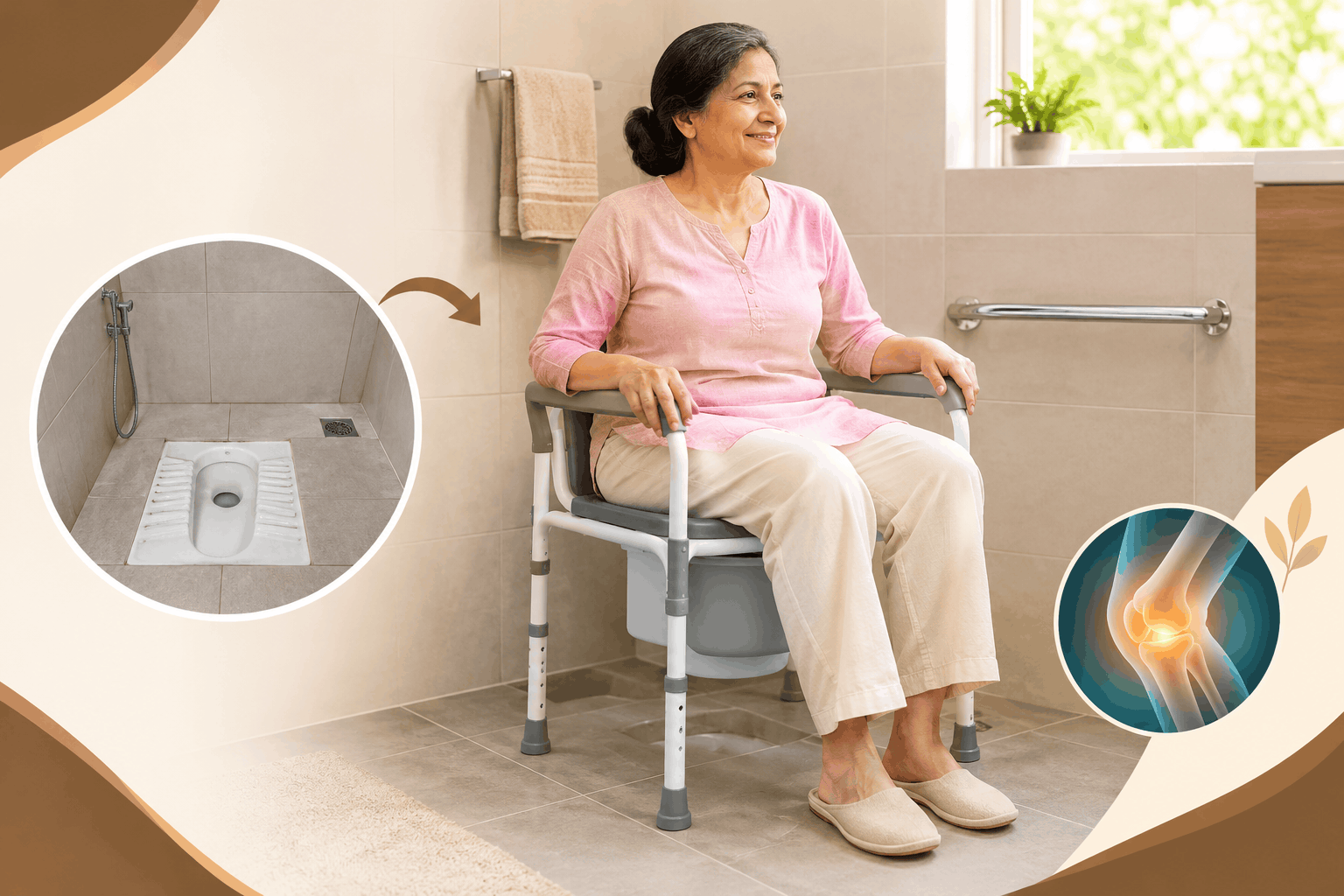
Why an Indian Toilet After Knee Replacement Is Harder Than It Looks
Most people think the problem is only how far the knee bends. In reality, a squat toilet asks your knee to do three separate jobs, one after the other:
- Bend deeply: you go down to a knee angle well beyond what normal daily life needs.
- Hold the position: thigh muscles must carry your body weight for as long as you remain squatting, often with no support.
- Rise again: standing up from a deep squat takes more strength and balance than going down, and this is where most falls happen.
After surgery, the thigh muscles are weak for several months and the soft tissues around the joint are still healing. That is why a position you managed easily at 40 can be unsafe at 8 weeks after a knee replacement, even when physiotherapy exercises feel comfortable. A wet bathroom floor and a night-time trip make it riskier still.
How Much Knee Bend Does Each Activity Need?
Knee bend is measured in degrees. A straight leg is 0 degrees. The figures below are approximate, and published studies differ because body build, hip flexibility and ankle movement change the result.
| Activity | Approximate knee bend | Usually possible after knee replacement? |
|---|---|---|
| Walking on level ground | 60-70 degrees | Yes, in the first weeks |
| Climbing stairs | 90-110 degrees | Yes, with practice |
| Sitting on a standard chair or Western toilet | About 90-105 degrees | Yes |
| Getting up from a low sofa or low stool | 110-120 degrees | Often, with arm support |
| Sitting cross-legged | Roughly 105-130 degrees, plus hip rotation | Only some patients, later in recovery |
| Full squat or Indian toilet | About 127-140 degrees or more | Uncommon |
Most knee replacements settle somewhere between 110 and 130 degrees of bend. That is comfortable for everything in the first four rows, but it leaves little or no margin for a deep squat. That is why squatting after knee replacement is the most demanding movement on the list. One interesting point: sitting cross legged after knee replacement may need slightly less knee bend than squatting, yet it also needs hip rotation and ankle movement. A patient with a stiff hip may find it harder than the knee figure suggests.
Set Up Your Bathroom Before You Come Home
The best time to prepare for an Indian toilet after knee replacement is before surgery, not on the first night at home. Use this checklist:
- Place a sturdy commode chair after knee replacement, with arm rests, over the Indian pan, or fit a raised Western seat if the bathroom allows it.
- Fix a grab bar at hand height beside the toilet and another near the entrance. A towel rail is not strong enough.
- Put anti-skid mats on wet areas and keep the floor as dry as possible.
- Install a night light on the path from bed to bathroom.
- Keep your walker or stick within reach of the door, and wear rubber-soled footwear, not wet bathroom slippers.
- Ask a family member to stay within calling distance for the first week.
Washing and Hygiene When You Cannot Bend Much
This is the practical side of using an Indian toilet after knee replacement that patients rarely mention but often struggle with. Most households use water for cleaning, and reaching down with a mug while seated on a commode can strain a stiff knee and a sore back. A few simple fixes help:
- Install a hand-held health faucet within easy reach of the seat.
- Keep a long-handled wiping aid or a bidet attachment if reaching is difficult.
- Eat fibre-rich food, drink enough water and follow your medicine plan. Constipation is common after surgery, and straining on the toilet is uncomfortable and unsafe in the early weeks.
- If you have shoulder pain as well, getting up from a commode is harder. Pushing up with weak arms is a known problem for people with a rotator cuff injury, so mention it to your surgeon before the operation.
A Stage-by-Stage Guide for Toilet and Floor Use
Every knee heals at its own pace, so treat this as a general outline for using an Indian toilet after knee replacement and for floor sitting after knee replacement. Always follow your own surgeon’s instructions. You can see the full recovery picture in our knee replacement recovery timeline.
| Stage | Toilet | Floor and prayer seating |
|---|---|---|
| Weeks 0-6 | Commode chair or raised seat only, with a grab bar | Chair or bed. No floor sitting, no kneeling |
| Weeks 6-12 | Keep the commode. Walking and strength are still building | Raised seating. Avoid low seats and twisting |
| 3-6 months | Still the commode for most. Ask your surgeon before any trial | A short supervised trial may be allowed for some patients |
| 6-12 months | Occasional use only if cleared, with a rail and good balance | Short sessions on a thick mat if comfortable |
| After 1 year | Your final range is usually clear. Many choose the Western seat for good | Depends on bend, strength and comfort |
Many surgeons advise a Western seat for the long term even when a patient can manage a squat, because balance and falls are as much a concern as the implant itself.
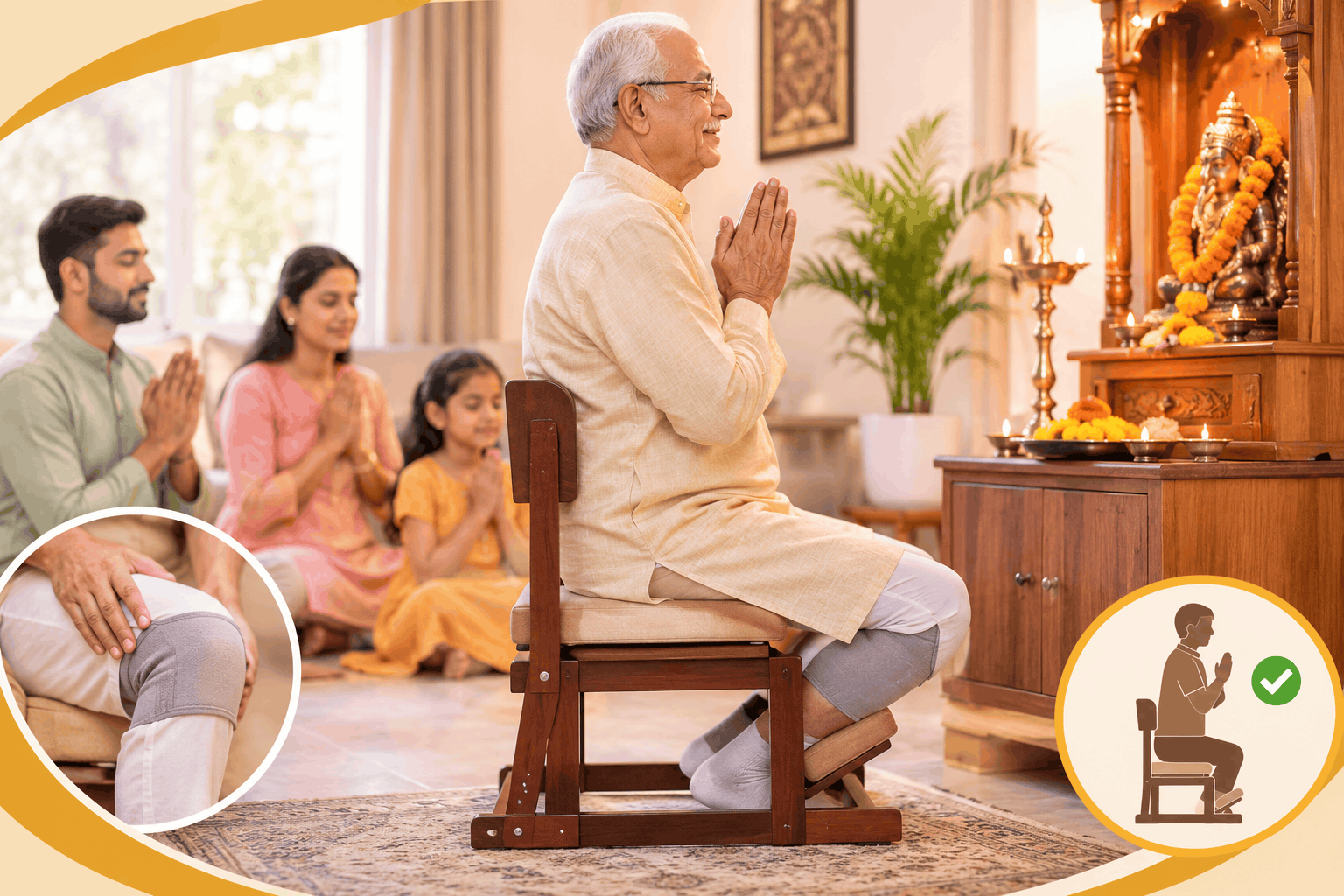
Meals, Puja, Namaz and Family Functions Without the Floor
Limiting floor sitting after knee replacement does not mean giving up your place in the family. Small adjustments let you stay part of every occasion:
- Meals: use a dining table or a firm chair with a tray. At weddings and community meals, ask for a chair at the edge of the row.
- Puja and prayer: a prayer chair or a raised platform lets you join in without kneeling. Many people of every faith now use chair-based prayer after joint surgery.
- Sleeping: a bed at normal height is safer than a floor mattress. If you must use one, keep it thick and keep a sturdy chair beside it to push up from.
- Playing with grandchildren: sit on a chair and let the children come to you rather than going down to their level.
- Kneeling: the skin in front of the knee can stay tender for months. If your surgeon allows kneeling, use a soft cushion and keep it short.
- Travel and temples: carry a light folding stool for places where you must wait or sit for long periods.
If Your Surgeon Clears a Trial: How to Try It Safely
Some patients do regain more bend than expected, especially those who were flexible before surgery. If your surgeon agrees you may test squatting after knee replacement or other deeper positions, go in small steps and never as a dare:
- Start with supported half-squats at a kitchen counter, holding on with both hands.
- Practise standing up from a lower chair without pushing hard with your hands.
- Try a deeper bend only with someone beside you and a fixed support to hold.
- Judge the first attempt by how the knee feels the next morning. New swelling, heat or stiffness means it was too much.
- Treat the rise as the real test. If you cannot stand up smoothly and slowly, you are not ready.
Do not use a full squat as a test of whether your recovery is going well. A knee that is healing well can still be unsuited to deep bending.
Does Robotic Surgery or a High-Flexion Implant Change the Answer?
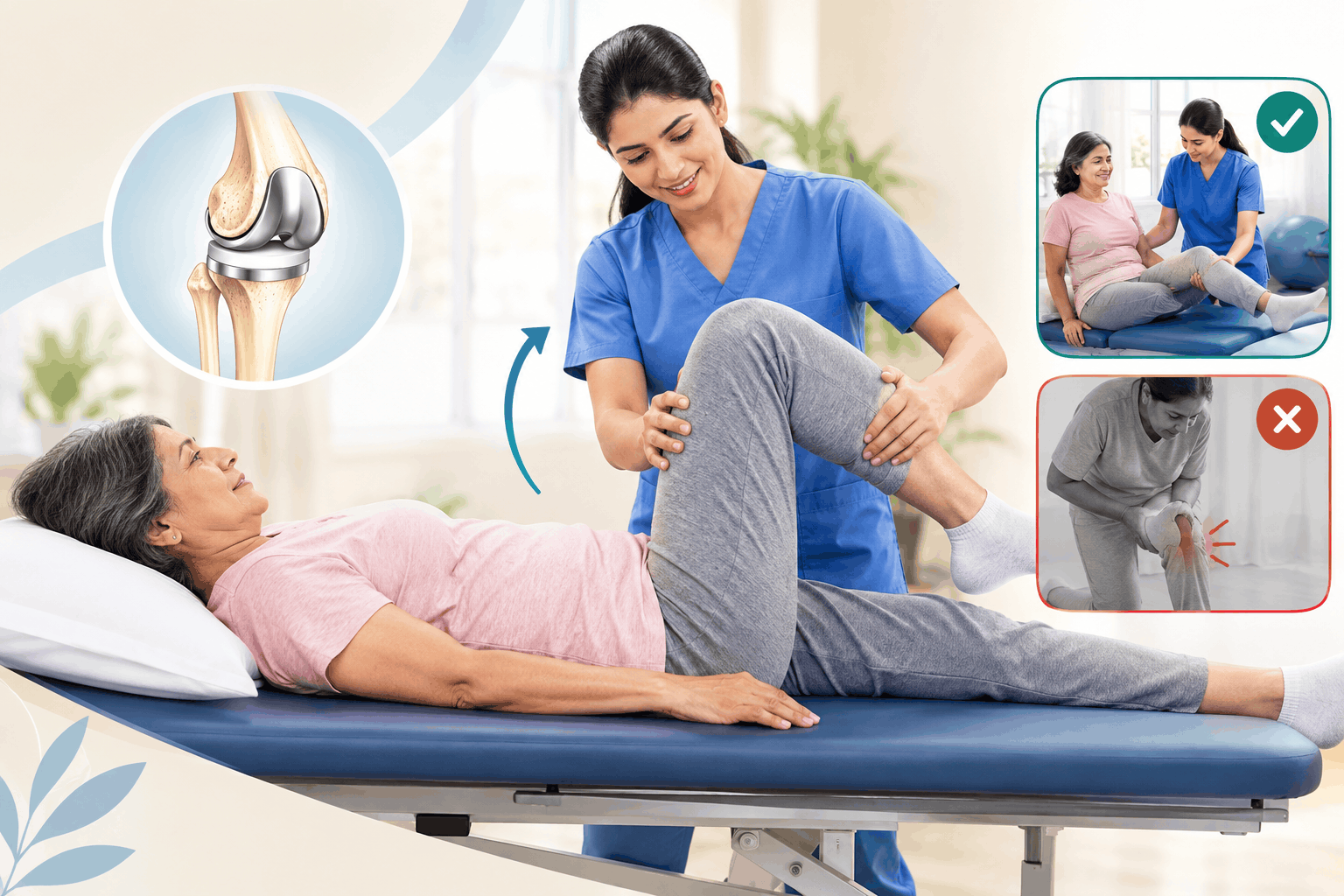
Patients often hope the answer is yes. The honest answer is: only partly. Robotic assistance helps the surgeon plan bone cuts and position the implant accurately, which supports smooth movement and balanced ligaments. You can read more about it on our page for the best robotic knee replacement surgeon in Noida.
What neither robotic technology nor special implants can do is change your body. How far your knee bends after surgery depends mainly on how far it bent before, the strength of your muscles, your hip and ankle movement, your weight and how regularly you do your physiotherapy. High-flexion designs have not been shown to give reliably better bending in clinical trials. If floor activities matter to you, say so at your first consultation so the plan can be built around your lifestyle.
Warning Signs: When to Stop and Call Your Surgeon
- Sharp pain at the front or sides of the knee when bending
- Swelling, warmth or redness that appears or increases after trying a position
- The knee feeling unstable or giving way, or any fall
- A bend that is getting worse instead of better despite regular exercise
- Calf pain or swelling, or fever with a red or leaking wound
Chest pain or sudden breathlessness is an emergency. Go to the nearest hospital immediately.
Will You Be Unhappy If You Cannot Squat?
Almost certainly not. Many patients who never return to an Indian toilet after knee replacement are still very happy with the result. An Indian study of 74 patients (120 knee replacements) found that 69 were satisfied overall, yet only 5 of them could squat or sit cross-legged. Pain relief and the ability to walk well were what made patients happy, not floor posture. You can read the study in the Indian Journal of Orthopaedics (PMC).
Hearing from people who have been through it can also ease the worry. You can read some patient testimonials, watch exercise and recovery clips in the video gallery, or browse the media gallery.
Questions to Ask Your Surgeon Before Surgery
- How far does my knee bend today, and what range can I realistically expect?
- Is my hip or ankle stiffness likely to limit floor sitting?
- What should I buy or fit in the bathroom before I come home?
- Will I be able to use an Indian toilet after knee replacement, and at what stage can I try a supervised squat or floor sitting, if at all?
- Do my other conditions affect healing and rehabilitation? For example, steady blood sugar matters for recovery, and our guide on knee replacement for diabetic patients explains how.
Asking these early means there are no surprises later. You can learn more about the surgeon on the about Dr. Sanjay Gupta page. Patients from across Delhi NCR consult him, and those living on the eastern side can also see the page for the best orthopaedic doctor in East Delhi. Consultations take place at SG Clinic in Wave City Centre, Sector 32, Noida.
Conclusion
A knee replacement is meant to take away pain and give you back walking, stairs and sleep. It is not designed to return every deep floor posture. Plan a safe bathroom for your Indian toilet after knee replacement, use a commode chair early, protect yourself from falls and let your surgeon tell you when, and whether, to try floor sitting, squatting or sitting cross legged after knee replacement. Most patients find that life with a Western seat and a chair for prayer and meals is comfortable and independent. If you are worried about how surgery will fit your daily routine, book a consultation and talk it through before you decide.
This article is for general information and is not a substitute for personal medical advice.
Frequently Asked Questions
When can I use an Indian toilet after knee replacement?
Not in the first 6 to 12 weeks, and often not for 3 to 6 months or longer. Many surgeons recommend a Western seat permanently. If you want to try, ask your surgeon to check your knee bend and strength first, and use a grab bar.
What can I use instead of an Indian toilet after knee replacement?
A commode chair after knee replacement, with arm rests, placed over the Indian pan is the easiest option. A raised Western toilet seat or a full Western toilet is better still. Add a grab bar and a non-slip mat.
Is floor sitting after knee replacement allowed for meals or puja?
Not early on. Use a chair or raised seat first. Later, short floor sessions on a thick mat may be possible for some patients, but getting down and up safely matters as much as the bend itself.
Will squatting after knee replacement damage my knee implant?
One careful attempt after clearance is unlikely to harm it. Repeated deep squatting, especially when it hurts or causes swelling, adds stress to the joint and soft tissues and is usually discouraged. Falls from a squat are a bigger immediate risk.
Is sitting cross legged after knee replacement easier than squatting?
It can need a little less knee bend, but it also needs hip rotation and ankle movement, so it is still difficult for many patients. Do not force it, and stop if you feel pain or pressure.
Does robotic knee replacement let me squat more easily?
Robotic assistance improves planning and implant positioning, but it does not change the limits of your anatomy. Your bend after surgery depends mainly on pre-surgery flexibility, muscle strength and rehabilitation.
How can I improve my knee bend safely?
Follow a regular, supervised physiotherapy plan, keep swelling under control and build thigh and hip strength. Gradual progress works better than forcing the knee, which usually causes swelling and slows recovery.
Can I be satisfied with my surgery if I never squat again?
Yes. Studies in Indian patients show that most people are satisfied when their pain is gone and they walk well, even without squatting or cross-legged sitting.
SG Clinic – Noida
📍 3D-5L, Wave City Centre, Sector 32, Noida – 201301

